About
cpp implementation of Bloom Filter, Shifting Bloom Filter, Spatial Bloom Filter, and other variants like partition filter, dynamic filter.
Todo Lists
- 复现Bloom Filter
- 复现Shifting Bloom Filter
- 复现Spatial Bloom Filter
- 数据集
- 高斯分布(1e7)
- 指数分布(1e7)
- 均匀分布(1e7)
- 其他分布
- 针对实现的后两种数据结构的其中一种或者两种进行改进,并选择合适的比对方式进行对比分析。
- partition filter
- partition shifting filter
- dynamic bloom filter
- id filter https://github.dev/BlockLiu/IDFilter
Installation
#include"bf.h"
using namespace filter;
数据结构
过滤器基类
我定义过滤器基类可以
- 添加元素
- 查询元素存在性
- 打印内部信息(可删除)
class BaseFilter
{
public:
	virtual void add(uint64_t key) = 0;
	virtual bool query(uint64_t key)const = 0;
	virtual std::string to_string() const = 0;
	virtual ~BaseFilter(){}
};
经典布隆过滤器
Bloom过滤器是一种空间效率的概率数据结构,由Burton Howard Bloom在1970年提出,用于测试一个元素是否是集合的成员。假阳性匹配是可能的,但假阴性不可能,只需要少量的内存就可以存储大量的信息
 Picture is From:The Prefix Filter: Practically and Theoretically Better Than Bloom. VLDB 2022
Shifting Bloom Filter
布隆过滤器的改进版本,引入了 存储额外的信息,并且可以只通过一次 hash 同时设置两个 bit

References: T. Yang et al., “A shifting bloom filter framework for set queries,” Proc. VLDB Endow., vol. 9, no. 5, pp. 408–419, Jan. 2016, doi: 10.14778/2876473.2876476.
membership
使用一半的hash函数,然后额外取一个作为 offset,每次添加/查询元素 e 时将 和 都设为1. 优点:同时访问两个bit 缺点:相同参数下,更高的误判率
association
专门用于集合查询的Shifting Bloom Filter,需要两个集合 ,根据元素 e 在中的存在情况不同,设定不同的offset。在查询时根据offset不同判断元素的存在信息。
Spatial Bloom Filter

References:
- P. Palmieri, L. Calderoni, and D. Maio, “Spatial Bloom Filters: Enabling Privacy in Location-Aware Applications,” in Information Security and Cryptology, vol. 8957, D. Lin, M. Yung, and J. Zhou, Eds. Cham: Springer International Publishing, 2015, pp. 16–36. doi: 10.1007/978-3-319-16745-9_2.
- 作者官网:Spatial Bloom Filters
- 作者在线演示:live demo
Partition Bloom Filter
造成布隆过滤器误判的一大原因就是和其他hash冲突,可以将所有比特数组分成几个桶,每个桶单独一个hash,那么每一个hash函数只会和自己之前的hash冲突。
Reference: Chang, F., Feng, W. C., & Li, K. (2004, March). approximate caches for packet classification. In INFOCOM 2004. Twenty-third AnnualJoint Conference of the IEEE Computer and Communications Societies (Vol. 4, pp. 2196-2207). IEEE. (Full text article)
Scalable Bloom Filter
动态布隆过滤器,在内存允许的情况下可以存储理论无限的数据,不需要某个先验的最大输入规模。
下图展示了一个Scalable Bloom Filter的基本模型(下文简称SBF)。该SBF一共包含BF0和BF1两层。在一开始,SBF只包含BF0层,假设在插入a、b、c三个元素后,BF0层已经无法保证用户设定的误判率,此时会创建新的一层(BF1层)进行扩容。因此,后面的d、e、f元素会插入到BF1层中。同理,当BF1层也无法满足误判率时,会创建新的一层(BF2层),如此进行下去。Scalable Bloom Filter只会向最后一层插入数据,同时也从最后一层开始查询,直到查询至BF0层。
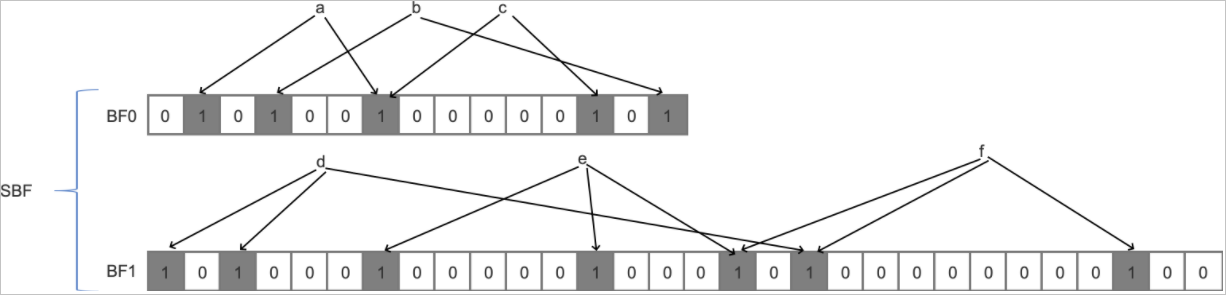
Reference: ALMEIDA, Paulo Sérgio, BAQUERO, Carlos, PREGUIÇA, Nuno, et al. Scalable bloom filters. Information Processing Letters, 2007, vol. 101, no 6, p. 255-261. (Full text article)
My Filter
Partition + Shifting
造成 shifting 错误率的一大原因就是和其他hash冲突,或者与其他hash的offset冲突,那么可以将其限定到一个桶里。在数据量较小时,冲突率会很大,但是当数据量达到 1e9 甚至 1e10 时桶中冲突的概率就会大大减小。
Spatial + Shifting + ID
Spatial一个area就占用1个或者2个byte,那么如果有255个area还好,利用率100%,但是在256时就得分配2个byte,这时候有7个bit没有用到,几乎浪费了一半的空间
- ID bloom filter 可以提高空间利用率,它不再已byte为单位,而是看看最多几个bit能装下。因为,不再占用整数个字节,那么寻址也不是字节位置,为避免对原有信息产生影响,使用或运算而不是加法。
- Shifting 将 offset 作为一个hash,这时候可以一次选择并处理两个 area(不是bit了)
Tests
数据集
def vis_dataset(file_path):
    df = pd.read_csv(file_path, sep=' ', nrows=int(1e6), header=None, names=['number', 'exists'])
    plt.hist(df['number'], 1000, histtype='step', density=True)
    plt.title(file_path.split('/')[1])
    plt.show()
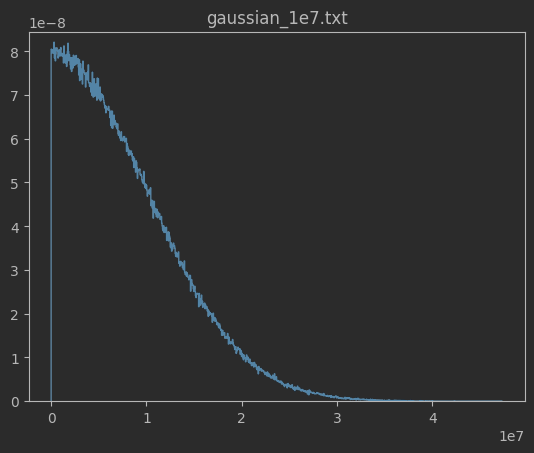
正态分布
均匀分布

指数分布

False Positive Test

Performance Test

references
- GitHub - Callidon/bloom-filters: JS implementation of probabilistic data structures: Bloom Filter (and its derived), HyperLogLog, Count-Min Sketch, Top-K and MinHash
- T. Yang et al., “A shifting bloom filter framework for set queries,” Proc. VLDB Endow., vol. 9, no. 5, pp. 408–419, Jan. 2016, doi: 10.14778/2876473.2876476.
- L. Calderoni, D. Maio, and P. Palmieri, “Bloom filter variants for multiple sets: a comparative assessment,” jucs, vol. 28, no. 2, pp. 120–140, Feb. 2022, doi: 10.3897/jucs.74230.
- S. Z. Kiss, “Bloom Filter with a False Positive Free Zone,” p. 12.
- H. Dai, “Bloom Filters and its Variants,” p. 90.
- B. Mößner, C. Riegger, A. Bernhardt, and I. Petrov, “bloomRF: On Performing Range-Queries in Bloom-Filters with Piecewise-Monotone Hash Functions and Prefix Hashing,” p. 13.
- S. Negi, A. Dubey, A. Bagchi, M. Yadav, N. Yadav, and J. Raj, “Dynamic Partition Bloom Filters: A Bounded False Positive Solution For Dynamic Set Membership (Extended Abstract).” arXiv, Jan. 19, 2019. Accessed: Nov. 16, 2022. [Online]. Available: http://arxiv.org/abs/1901.06493
- M. G. Solomon, V. Sunderam, L. Xiong, and M. Li, “Enabling mutually private location proximity services in smart cities: A comparative assessment,” in 2016 IEEE International Smart Cities Conference (ISC2), Sep. 2016, pp. 1–8. doi: 10.1109/ISC2.2016.7580757.
- P. Liu et al., “ID Bloom Filter: Achieving Faster Multi-Set Membership Query in Network Applications,” in 2018 IEEE International Conference on Communications (ICC), Kansas City, MO, May 2018, pp. 1–6. doi: 10.1109/ICC.2018.8422627.
- P. S. Almeida, C. Baquero, N. Preguiça, and D. Hutchison, “Scalable Bloom Filters,” Information Processing Letters, vol. 101, no. 6, pp. 255–261, Mar. 2007, doi: 10.1016/j.ipl.2006.10.007.
- P. Palmieri, L. Calderoni, and D. Maio, “Spatial Bloom Filters: Enabling Privacy in Location-Aware Applications,” in Information Security and Cryptology, vol. 8957, D. Lin, M. Yung, and J. Zhou, Eds. Cham: Springer International Publishing, 2015, pp. 16–36. doi: 10.1007/978-3-319-16745-9_2.
- T. M. Graf and D. Lemire, “Xor Filters: Faster and Smaller Than Bloom and Cuckoo Filters,” ACM J. Exp. Algorithmics, vol. 25, pp. 1–16, Dec. 2020, doi: 10.1145/3376122.
- Bloom, B. H. (1970). Space/time trade-offs in hash coding with allowable errors. Communications of the ACM, 13(7), 422-426. (Full text article)